Category: podcast

  • MobileViews 607: From Heathkits to 3D Printers & Vibe Coding: Redefining Making for the Next Generation


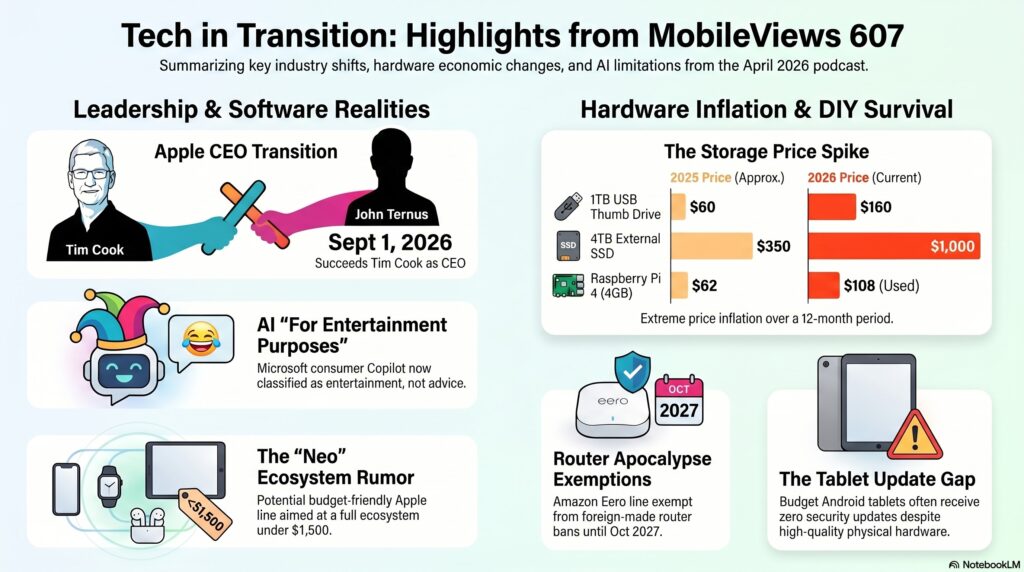
    Jon Westfall and I kicked off episode 607 with the news that Tim Cook is stepping down as Apple’s CEO to become Chairman, with John Ternus taking the helm this September. We speculated that his leadership might usher in a full “Neo” ecosystem—budget-friendly iPads and iPhones—that could finally bring the cost of a complete Apple setup under $1,500 for students. Jon is already leaning into this student-centric future by using NotebookLM to “chunk” his 75-minute lectures into digestible videos and activities, a strategy that is saving him hours of summer prep.

    I spent some time on a “mini rant” about the state of budget Android tablets; while you can find great hardware for under $150, these devices almost never receive security or OS updates, effectively making them disposable e-waste. On the infrastructure side, the “router apocalypse” continues as the FCC’s ban on foreign-made hardware looms, though Amazon Eero recently secured an exemption through October 2027. To prepare for a post-exemption world, I’m preparing to experiment with OpenWrt on an old travel router.

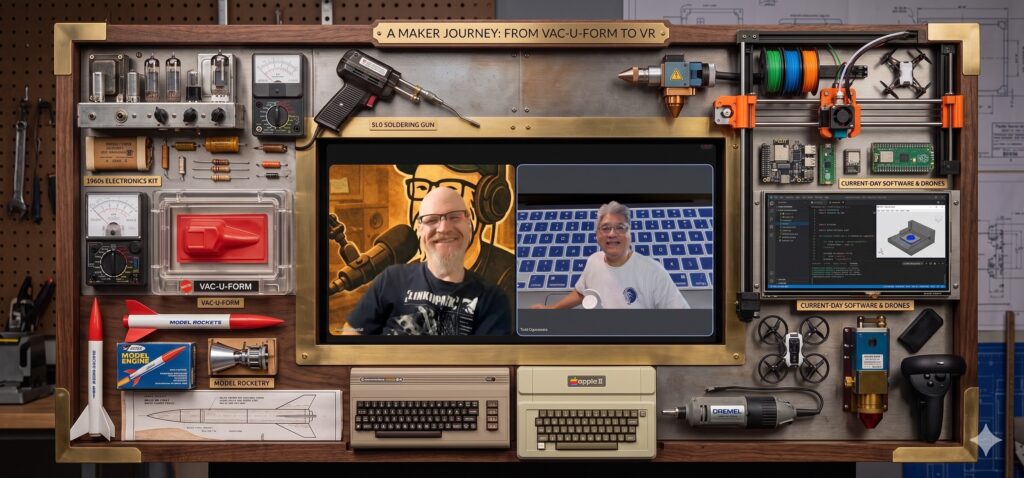
    We wrapped up with a look at the startling 2026 price hikes for storage—where a SSD drive that cost $350 last year is now nearly $1,000—and a discussion of encouraging  maker culture for young people. We debated whether encouraging preteens to use 3D printers and AI coding tools like Codex is better than traditional hobbies, reflecting on the Heathkits and “dangerous” chemistry sets of my own youth.


    Available via Apple iTunes.
    MobileViews YouTube Podcasts channel
    MobileViews Podcast on Audible.com
  • MobileViews Podcast 605: Google Gemini Notebooks; democratization of app dev?; guest: Steve Hughes


    In this podcast Jon Westfall and I were joined by our long-time friend Steve Hughes, who returned to the show after a long period of heavy travel. I used the opening of the show to test a new Boya CM40 condenser microphone, comparing its sound quality to my MacBook’s built-in mic, my 4K USB camera, and my AirPods. It is always fun to play with new toys..

    I have become a massive fan of NotebookLM and the new notebooks feature within Google Gemini. I recently fed hundreds of our podcast show notes and blog posts into a Gemini notebook to see how it handled the data. We discussed how this technology is becoming popular in academia as a tool for students to engage with material, though it poses a significant threat to the textbook industry by easily creating the same supplemental materials publishers charge for,. I’ve even been using it to build animated video presentations and conduct additional research, which are features included in the $20-a-month AI Pro subscription,.

    Our conversation turned toward the concept of digital sovereignty,” a movement in the European Union to reduce dependency on U.S. tech giants. We looked into the history of open-source office suites, from StarOffice to the current fragmentation of LibreOffice,. Interestingly, the EU is now looking toward “EuroOffice,” a fork of OnlyOffice (which itself has roots in Latvian and Russian development) to replace Microsoft Office. Steve, Jon, and I debated whether this would be a cleaner transition than past attempts, especially as corporate customers grow increasingly annoyed with the “nickel and diming” of subscription services.

    Jon and I revisited the “technology gap” we see in students who have grown up exclusively on Chromebooks. Many struggle with the basic concept of a file structure or how to actually download a file to a specific directory. My own daughter recently joked that Windows is for “old people,” which signals a shift Microsoft should be wary of. However, Jon shared a positive note on the democratization of app development. He built a purpose-built fitness timer for his strength training in just 20 minutes using AI. While this “one-two punch” of AI interviewing and coding is powerful, I cautioned against the “Microsoft Access problem”—the risk of non-programmers building mission-critical tools that lack documentation or error-checking.

    On the hardware front, Jon shared his first impressions of the MCON controller, a slider-style mobile gaming device that features a built-in MagSafe stand. While the buttons are a bit small for some, its “pocketability” makes it a strong contender for travel,. Steve updated us on the Sea Otter Classic, essentially the “CES for bikes,” highlighting new e-bike motors that are rejuvenating the industry,. We also touched on the EV market, specifically the Scout SUV and its move toward a range-extending motor. Steve even noted a great practical tip: using an EV as a reverse-load power source to keep a refrigerator running for up to two weeks during a blackout.

    Listen to the full podcast to hear Steve’s story about meeting will.i.am at CES.


    Available via Apple iTunes.
    MobileViews YouTube Podcasts channel
    MobileViews Podcast on Audible.com
  • MobileViews 604: Google AI Pro 5TB; Google FlexOS USB stick; Apple 50th; guest Sven Johannsen


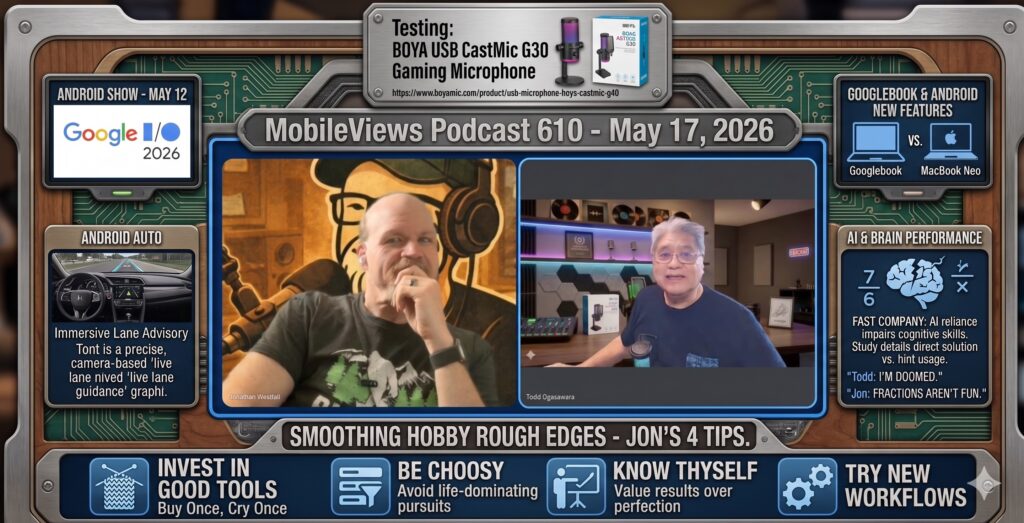
    Jon Westfall and I were joined by Sven Johannsen for MobileViews Podcast 604. We spent a good portion of the show reflecting on a major milestone: Apple turned 50 on April 1st. Beyond the nostalgia, we dove into Google’s latest AI subscription changes and some clever new hardware gadgets..

    I’ve been getting a lot of mileage out of Google AI Pro, and they recently gave their subscription service more value by bumping the storage from 2TB to 5TB for the same $200-a-year price. One of the most impressive new features is NotebookLM’s cinematic video creation, which I used to analyze and summarize 18 years of our own podcast history. We also discussed Google Flex OS, which now offers a three-dollar bootable USB stick for people who want a low-barrier way to try Chrome OS on their existing hardware.

    We shared our “origin stories” with Apple, and it was a fun look back at how the technology evolved: I also recounted my favorite customer service story from 2010, where an email to Steve Jobs’ office resulted in me getting a launch-day iPad despite a UPS delivery delay—and UPS actually made its first-ever Saturday delivery in my region just to get it to me and other iPad pre-order customers..

    We revisited the MacBook Neo. While critics focus on the 8GB RAM limit, the build quality is miles ahead of the “plasticky, bendy” Chromebooks that dominate the budget market. Jon noted that his students are the real target for this device; they want to be in the Apple ecosystem but often can’t afford the Pro models, making the $499 education price a potential game-changer.

    We closed out the episode with discussions of the WiFiPorter Sven bought to provide guests to his home with a seamless guest WiFi connection and the MCON magnetic transforming game controller that Jon recently purchased.

    Available via Apple iTunes.
    MobileViews YouTube Podcasts channel
    MobileViews Podcast on Audible.com
  • MobileViews 600: Looking back and looking forward – especially the new budget MacBook Neo


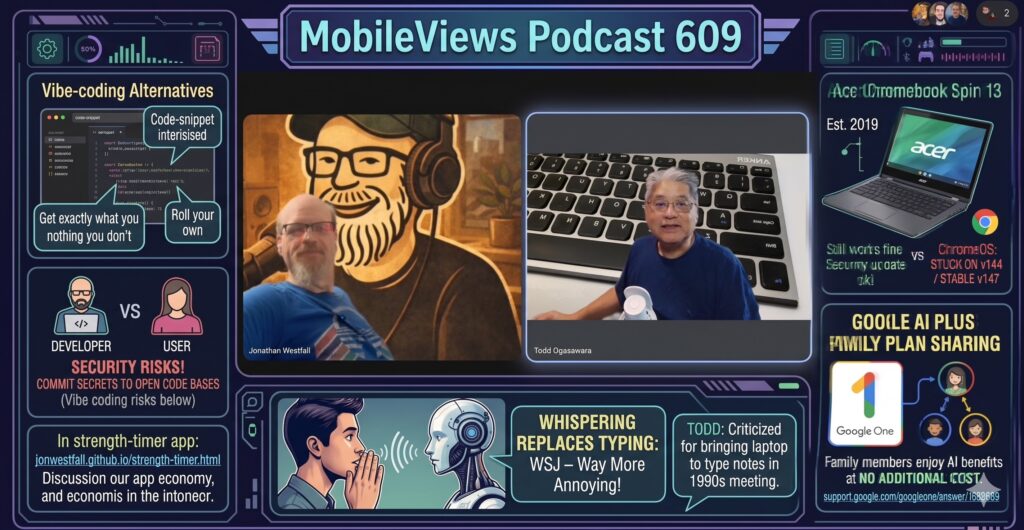
    Jon Westfall and I (Todd Ogasawara) were joined by frequent guest panelist Frank McPherson who was on the podcast with me way back in 2008.

    Frank first joined us all the way back on Podcast #2 on Nov. 28, 2008, when the hot topic was the T-Mobile G-1—the very first Android phone. Jon hopped on board with Podcast 69 on Dec. 22, 2013, to discuss the transition from Windows Mobile/Phone to other platforms and Microsoft Project Siena.

    We also mentioned frequent guest panelists Sven Johannsen and Jack Cook on Podcast 109 in Feb. 2015, discussing the state of Windows Phone two years before it was discontinued.

    Our discussions included Apple’s upcoming 50th anniversary on April 1, my anticipating the delivery of the new “budget” MacBook Neo A18 Pro powered laptop, Frank’s skeptic’s few on “what is low cost?”, and the Google March 2026 Pixel Drop. A key part of our discussion was how Android devices extend seamlessly to connected displays. This feature was previously enabled only in developer mode but is now a standard capability.

    Frank had some specific thoughts about Android desktop mode on his blog. I noted that while my Pixel 10 Pro supports this, I was disappointed to find that neither the Pixel Tablet nor the Samsung Galaxy Tab S10 FE does.

    Jon showed off his latest project: an Elecrow e-Ink screen which will be a remotely programmable office door sign. We also discussed the Elecrow CrowView Note, which is an interesting portable monitor with keyboard that functions as a “phone-to-laptop” device (somewhat reminiscent of the old Celio REDFLY Mobile Companion).

    Available via Apple iTunes.
    MobileViews YouTube Podcasts channel
    MobileViews Podcast on Audible.com
  • MobileViews 598: Budget MacBook soon? E-ink vs. OneNote. “Vibe Working”


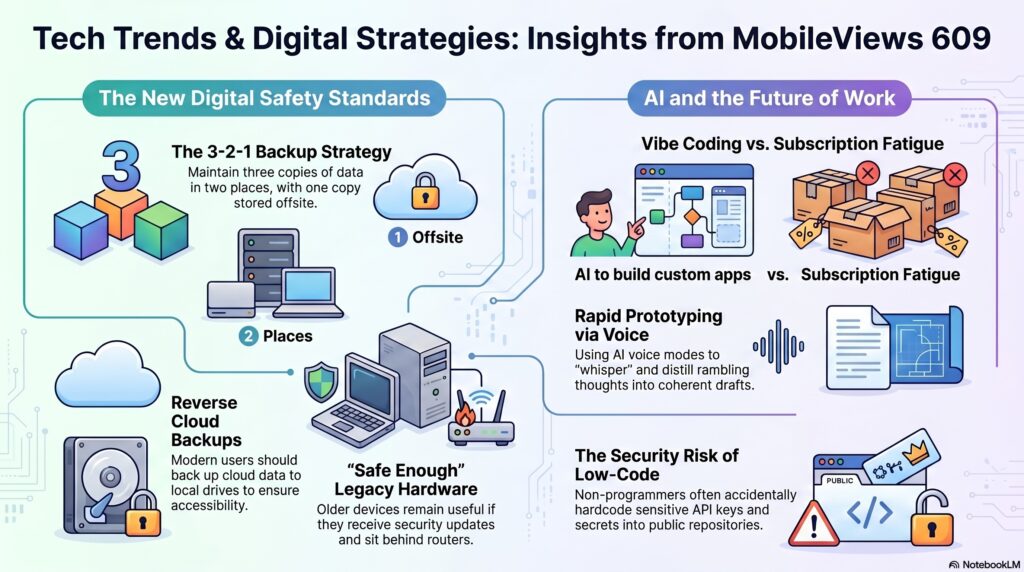
    As we inch ever closer to episode 600, we spent some time reflecting on our podcasting journey and the accelerating pace of our 100-episode milestones. It feels like just yesterday I started this show during a brief stint as a full-time blogger, and I’m incredibly grateful for Jon Westfall and all the friends who have stepped in to keep the show running consistently over the past 18 years.

    Tech News & Announcements

    Jon Westfall and I (Todd Ogasawara) covered several major industry updates and rumors this week:

    E-Ink Troubleshooting: Boox Note Air5 C

    I provided an update on the Boox Note Air5 C and a frustrating e-ink lag problem when using Microsoft OneNote. This writing lag is a known issue. The current solution when dealing with OneNote’s infinite scrolling is simple but annoying: don’t write near the very bottom of the display. Note that this specific issue doesn’t seem to happen on the iPad or conventional Android tablets—it is strictly an e-ink quirk.

    Workplace Feedback, “Vibe Working,” and OneNote

    We moved into a deeper discussion about evaluating work and the ongoing challenges of providing workplace feedback. Jon has been evaluating the work of his peers lately in OneNote, and to say it’s not going well would be an understatement. We debated whether the fault lies with the tool itself or the user, leading into a wider conversation about the lack of attention to detail in professional environments.

    This tied perfectly into the difficulty of giving feedback to coworkers, especially when unreadable formatting or poorly optimized code directly impacts your own workflow. Finding that reasonable middle ground to deliver criticism without causing unnecessary friction remains a constant challenge.

    We introduced some new terms to frame this phenomenon, comparing Mark Zuckerberg’s old “move fast and break things” mantra against the reality that carelessness often speaks directly to competency. We coined phrases like Minimally Viable Product / Deliverable, Vibe Working, and Generation AI to describe these modern workplace dynamics.


    Available via Apple iTunes.
    MobileViews YouTube Podcasts channel
    MobileViews Podcast on Audible.com
  • MobileViews 597: Forced Cloud Storage, Exploding Batteries, and Near Future Tech


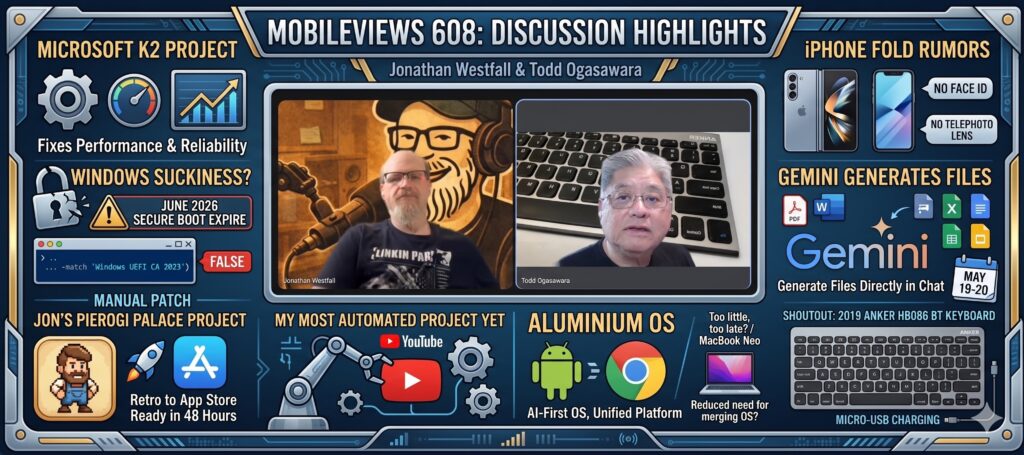
    This week on MobileViews 597, we dive into a series of mini-rants and discuss the future of low-cost computing, hardware prices, and AI features in mobile apps.Key Topics and Discussion Summary1. The Clipchamp/OneDrive Forced Storage Rant

    Microsoft’s recent update to its Clipchamp video editor, which forces all users to save their projects to OneDrive, has sparked a firestorm of negative feedback. Because video files are large, users with slow upload speeds (like ~25Mbps) are seeing performance slow to a crawl, and they are concerned about quickly maxing out their free cloud storage.

    The overwhelmingly negative community sentiment, as seen on a Microsoft Learn Q&A thread, includes:

    • Loss of Local Control: Users are angered by being forced into the cloud, with many migrating to alternatives like the Open Source ShotCut or Davinci Resolve.
    • Monetization Concerns: Many see the move as a deliberate tactic to push users into premium OneDrive subscriptions.
    • Bugs & UX Issues: The update has reportedly caused data loss and made the desktop app difficult to use.
    1. Hardware and Computing Futures
    • Apple and Chromebooks: There’s anticipation for a low-cost MacBook possibly featuring an A18 Pro processor. Meanwhile, the expected availability for a particular Chromebook model has been pushed back from 2026 to 2028 (aluminium-os). Jon is also looking forward to the next-gen Mac Mini.
    • Skyrocketing Hardware Costs: The prices of RAM, SSDs, and hard drives are surging due to AI-related data center demands. This raises the question of whether coders will return to valuing resource-efficient programming, reminiscent of the low-memory challenges on classic machines like the Apple II+ (PC Mag article).
    • Gemini in Google Photos: We detail the process of turning off the “Gemini AI” search feature in Google Photos. Users on a Pixel or Boox tablet can bypass the AI search with a simple double-tap on the Ask button. For a full disable on Android or iPhone, the setting is found under: Profile Picture > Photos settings > Preferences > Gemini features in Photos.
    1. Quick Hits
    • An unexpected mouse battery explosion in a trusty Logitech mouse.
    • Jon upgraded to a Backbone Pro gaming controller, noting that the Backbone line is a great “jack of all trades” device.
    • Jon’s Python Toolbox recommendations:

    Available via Apple iTunes.
    MobileViews YouTube Podcasts channel
    MobileViews Podcast on Audible.com