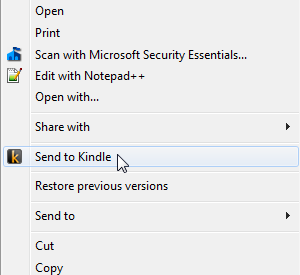
 I tried out the new Save to Kindle for Windows and it just worked. Here’s what I did:
(more…)
Category: Mobile Devices
-
Save to Kindle tip: View PDFs in landscape mode
-
Tip: Windows Phone predictive text works when using a physical keyboard too (unlike Android)
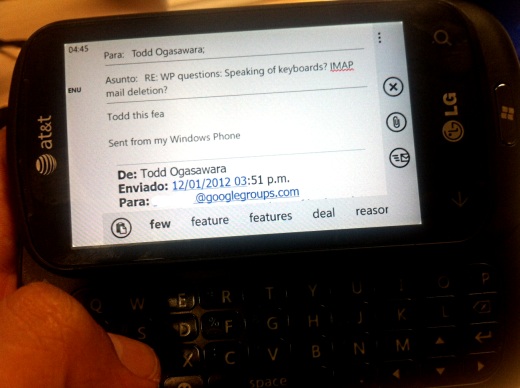
I’ve used a number of Android phones with physical QWERTY keyboards over the years (starting with the original T-Mobile G1). Having come from the Windows Mobile world, I never understood why Google turns off predictive text when using the physical keyboard. It only works when using the on-screen keyboard. This was a great feature in Windows Mobile phones with physical keyboard. I recently review the LG DoublePlay (BYTE) and LG myTouch Q (aNewDomain.net) Android phones and noticed that predictive text is still not available when using their physical keyboards.
(more…) -
Note to self: Save to Kindle for (Windows) PC available – great for reading documentation next to a PC
This is a very handy feature for all Kindle users. But, it is especially useful for people like me who often want to prop up a technical book/manual next to a PC for reference. Although I can already do this using, for example, GoodReader or iBooks on an iPad, doing so eats up the device’s battery and shuts off the display after some fixed period of inactivity. The e-ink Kindle, however, does not suffer from either problem when a page is left up on its display. The free app for Windows PC was announced on the Kindle Daily Post blog.
-
[Video] Demo of Sesame Street augmented reality toys & Android tablet using Qualcomm Vuforia tech
The Sesame Street toy figures and play surface have Augmented Reality (AR) registration markers that are recognized by the software running on the HTC Android-based tablet used in the demo.
-
Why Microsoft insists tablets run Windows instead of Windows Phone (Windows CE)
I’ve been wondering why Microsoft’s decision makers choose to use Microsoft Windows for tablets instead of the Windows CE platform that underlies Windows Phone. Windows CE was designed for devices like tablets that benefit from lower hardware requirements, lower power use, increased security, and instant on-off (suspend-resume). A Windows CE based tablet would be lighter and less expensive. More importantly, every piece of software written for a touch display. You could argue that the Metro-only ARM based tablets would have software designed just for tablet displays too. But, is a computer that can’t run “legacy” Windows software of much use? The point of using Windows is to access all the software available right now.
However, if you look at PC shipment numbers, Microsoft’s tablet strategy and statements like There’s nothing more important at Microsoft than Windows by CEO Steve Ballmer make sense (Network World).
(more…) -
Nokia Lumia 900 (Windows Phone): First Lumia with a front-facing camera. Still missing a few features
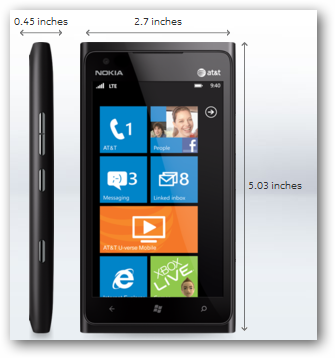 The first two Windows Phone devices Nokia announced late last year, the Lumia 710 and 800, looked like decent but unexciting phones. The phones were also missing a couple of feature checkboxes including a front-facing camera, NFC and LTE. The first 2012 Lumia model is the 900. How does it fare spec checkbox-wise?
+ 1 megapixel front facing camera
+ LTE (AT&T)
+ 4.3-inch display
+ Gyroscope
+ Two microphones (one presumably for noise cancellation)It is still missing a couple of features, however.
– No microSIM slot
– No NFC (something Nokia is pushing on its legacy platforms)It remains to be seen if the 900’s camera matches the spectacular quality of past Nokia (non-Windows Phone based) smartphones or is the so-so quality seen produced by the 710 and 800.
You can find the full Lumia 900 specifications at: