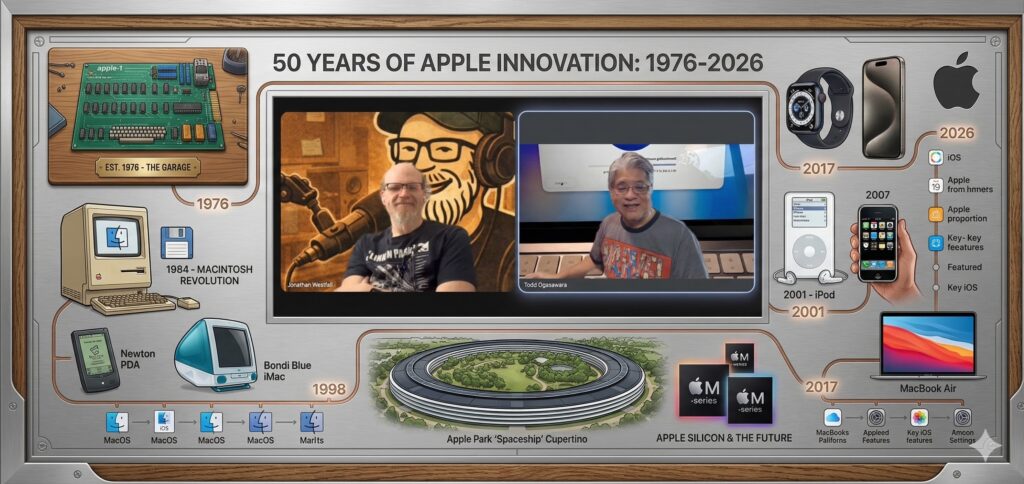
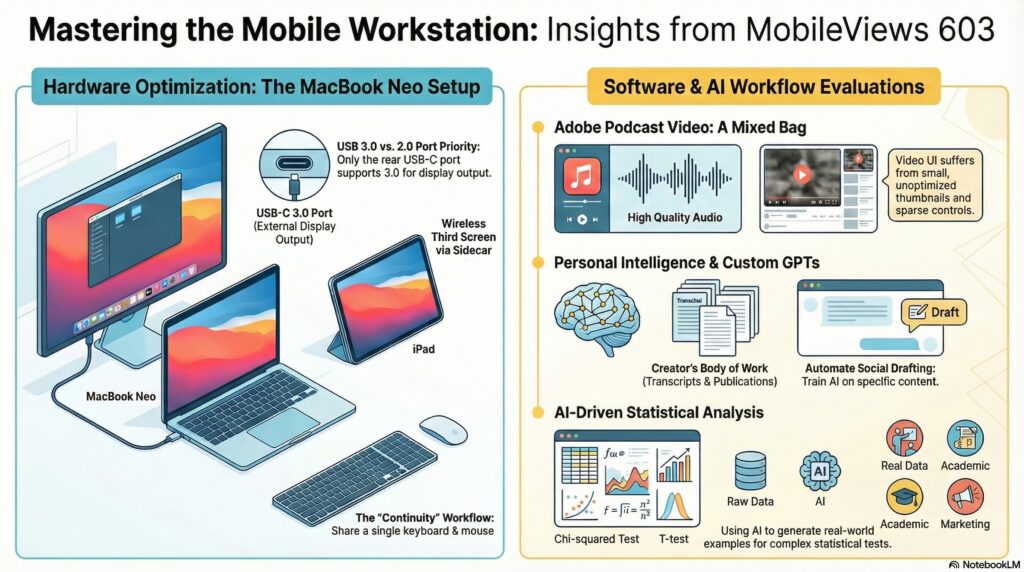
For MobileViews 603, recorded on March 29, 2026, I decided to return to my classic Blue Yeti Nano microphone, which I used for hundreds of episodes in years past. Much of our hardware discussion this week centered on my ongoing fascination with the MacBook Neo. I discovered that while it officially only supports one external display, you can effectively run a three-screen setup by using an iPad as a wireless third display through the MacOS Sidecar feature. This configuration, utilizing Mac OS Continuity, allows me to control the iPad using the MacBook’s keyboard and mouse, creating a highly functional workstation without the need for extra cables. Jon has adopted a similar workflow in his classroom, using an iPad alongside his MacBook to handle student attendance while presenting his slides.
On the software side, we discussed the release of iOS 26.4, which introduced a “Playlist Playground” feature in Apple Music on mobile devices. This tool uses AI to generate playlists from simple text prompts, and it serves as an excellent discovery tool for investigated genres where you might not be an expert. Looking further ahead, we looked at reports that iOS 27 may finally allow Siri to integrate with third-party AI chatbots like Gemini or ChatGPT. Since neither of us is a major fan of the current Siri, being able to choose a preferred chatbot would be a welcome change.
As we approached Apple’s 50th anniversary as an incorporated entity on April 1st, I reflected on the history of “tiny teams” in technology. While modern projects often involve hundreds of people, many of the most foundational tools—such as Apple DOS, CPM, and VisiCalc—were built by just one or two individuals. For instance, Paul Laughton built the first disk operating system for Apple in just 35 days by himself. We even saw this principle in action this week with Jon’s new project, “Different Enough”. He built this statistical testing website using GitHub Pages, TypeScript, and React in just 90 minutes. His secret was using ChatGPT to “interview” him about his requirements before generating a prompt for OpenAI Codex to build the final application.
We followed up on the Adobe Podcast video test from last week; while the speaker identification worked well for the transcript, I had to boost the output volume significantly in post-production because it was surprisingly low. Jon also shared a bug he encountered with the Plaud Note platform, which misidentified a speaker by tagging the same student profile 20 times across different meetings with different students.. On a more aesthetic note, I shared Casio’s announcement of a Japanese Lacquer Edition calculator. It is such a beautiful piece of craftsmanship that I’m now hoping Apple considers a lacquer edition for their MacBook line.
We finished up with a discussion of Jon’s latest vibe coding project, a web app called “Different Enough”. The site is designed to help users run various statistical tests to determine if data sets are actually significantly different from one another.
Available via Apple iTunes.
MobileViews YouTube Podcasts channel
MobileViews Podcast on Audible.com