Subscribe in a reader

October 2007


New Windows Mobile Site: The Wow Stops Now?

Microsoft launched a new Windows Mobile site that apparently has the slogan Start Doing More.

Microsoft Windows Mobile 6 Start Doing More

However, this heavily flash-based site seems to be about less instead of more. The initial page with its three tiny thematic buttons sitting in the middle of the screen looks lonely on the nausea inducing full motion video sitting in back of it. Clicking a button results in another long Flash site load that takes a long long time even on a broadband connection. This is not a sticky site design and offers little useful information. All flash, no substance.

Mobile Devices

Comments (0)

Permalink

Google Mobile Phone: T-Mobile or Verizon Wireless?

RCR Wireless News reports that T-Mobile may be the US carrier that launches the Google mobile phone.  Information Week reports that Verizon Wireless may be the lucky carrier. If Google uses Apple’s one carrier strategy for a mobile rollout, VZW seems like the more likely candidate since it has a much larger presence than the far smaller T-Mobile USA.

My guess, ok wishful thinking, is that Google has more clout than Apple (though that may be hard to believe) and is able to avoid the whole exclusive carrier agreement and roll out both a CDMA (VZW) and a GSM (T-Mobile) solution. VZW would give it the US footprint to compete effectively with the Apple/AT&T Wireless iPhone product. The T-Mobile GSM solution would give it worldwide roaming. The combined rollout would also have a larger customer population than AT&T Wireless.

I guess we’ll see how things shake out in the next couple of weeks if we believe the various reports and rumors published in the past few weeks.

Mobile Devices
Mobile Phones

Comments (0)

Permalink

T-Mobile Shadow: Here Come the Custom Interfaces

The T-Mobile Shadow has been generating a lot of interest (not as much as the iPhone did, but quite a lot in the scheme of things). Like most HTC designs, the slide-out keyboard design for a Windows Mobile 6 smartphone (Standard Edition) looks good. The odd thing (to me anyway) is that the Shadow is being marketed as a cool hip lifestyle music playing phone.

The issue is that Windows Mobile 6 is not designed for cool hip consumers. It is designed for uncool, unhip enterprises with Microsoft Exchange Server (which actually does some cool stuff with Windows Mobile but not in the sense of young people cool). Does putting an easier to use Today screen really make that much of a difference? Probably not IMHO. And, unless some significant enhancement was done to Windows Media Player for Windows Mobile, it does not have a good non-techie end-user story to tell as a media player.

The Shadow looks like a good solid Windows Mobile 6 smartphone. Its lack of a QWERTY keyboard probably takes it out of the e-mail focused crowd. It will be interesting to see which market segment actually gravitates towards these green and brown (brown?) phones.

Mobile Devices

Comments (2)

Permalink

Mailbag Q&A: Using a Mobile Phone for Heart Attack Care

Reader D.S. has an interesting question. I usually post interesting questions because I think the question and my response might be of general interest. This time, however, I’m posting it because I think the question needs a better response than I can provide. D.S. asks…

We are in the midst of setting up a system to improve the care for patients who are suffering a heart attack in the city and county of […]

One significant issue is how to to allow the cardiologist to see the electrocardiogram. This is important for the cardiologist to make a decision as to whether an emergent cardiac catheterization should take place.

Obviously if it is during business hours or if the cardiologist is at home and has a fax machine, this is not as much of an issue.

However, we need to address the possibility that the cardiologist on call is out and about. Hence the question about how a cardiologist might be able to view the electrocardiogram in the field.

One thought is for the cardiologists to have mobile devices. In my research of the topic, there do appear to be ways for a fax of the electrocardiogram to be sent to a mobile device. However, the worry is that there is still a delay, especially with a fax to email solution. In acute heart attack care, seconds and minutes count, so the image would need to be available in real time.

In your experience, what would you recommend as a way to get an image of the electrocardiogram to the cardiologist. Some way for the emergency room to send a fax of the electrocardiogram to the phone? Could it be send via MMS messenging?

First, here’s a caveat/disclaimer: My response here should not be considered as advice, recommendation, or consultation. It is merely a response to an interesting question. (Sorry for the weasel words :-).

Couple of thoughts…

1. First, before starting on the technical aspects of the project, be sure to consult with an authority in the Health Insurance Portability and Accountability Act (HIPAA). You may need to encrypt the electrocardiogram image for transmission.

2. As you point out both SMS and email are subject to potential delays. And, sending images may be problematic depending on how email is configured, the storage capacity of the receiver’s mail server, and other factors. It may be worth investigating the possibility of keeping multiple resolutions of individual images (low, medium, high) on the server and sending alerts to the cardiologist via simultaneous multiple channels: E.g., automated voice call, SMS, email. This message would point the receiver to a password protected site where the image could be called up on a mobile device for viewing.

3. Don’t rule out the possibility of an old-style client-server application where coded alphanumeric data is sent from the server to the client (mobile device) instead of a graphic image. An electrocardiogram image could be rebuilt from this smaller coded data. This could greatly reduce the amount of data that is sent compared to an image file and thus speed up the process of receiving and viewing the electrocardiogram image.

Here are links to two mobile technology sites that may provide more information than I can provide.

MedicalPocketPC.com

Smartphone & Pocket PC Magazine has an M.D. as a regular contributing author

Finally, if anyone has other information links that might be useful to D.S., please post it in a comment to this blog entry.
Mobile Devices
Pocket PC/Phone Edition
Q&A
Smartphone
Windows Mobile

Comments (0)

Permalink

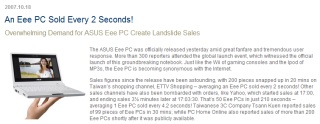
Concerned About Asustek Eee PC Math

Asustek Eee PC press release

The October 18 Asustek press release title for the eagerly anticipated (at least by me) ultra compact Eee PC reads…

An Eee PC Sold Every 2 Seconds

However, the text of the release says…

…with 200 pieces snapped up in 20 mins on Taiwan’s shopping channel, ETTV Shopping – averaging an Eee PC sold every 2 seconds!

Um, hmm, so 200 / 20 = 10 per minute = an Eee PC sold every 6 seconds. Still impressive but off by 3x. Not very good math. Hope it wasn’t calculated on an Eee PC :-)

Addendum: Here’s a link to CNET UK’s Asus EeePC 701 Full Review.

Mobile Devices
UMPC

Comments (0)

Permalink

Google Gmail IMAP4 Works Fine with Windows Mobile

My Google Gmail IMAP4 feature was turned on earlier today (Oct. 25, Thursday). The first thing I did was test it with a T-Mobile Dash (Smartphone AKA Standard Edition) running Windows Mobile 6. And, yep, WiMo’s Messaging (email) works fine with the new Gmail feature.

Google provides step-by-step instructions to configure Windows Mobile 6 to work with Gmail and IMAP4.

Google Mail Help IMAP Windows Mobile 6

However, experienced WiMo users may find the less eye-glazing generic help page faster to go through.

Google Mail Help IMAP Configuring Other Mail Clients

Google’s IMAP service seems a lot slower than service on other IMAP servers I use. However, it may simply be because of all the new clients being configured and downloading email. I’m hoping this will clear up (speed up) within a couple of days or weeks.

Addendum: Hey, I just noticed my Gmail storage is up to 4.3GB. When did that happen?

Mobile Devices
Pocket PC/Phone Edition
Smartphone
Windows Mobile

Comments (1)

Permalink

Issues With Recurring Meetings in Windows Mobile

Microsoft’s Jason Langridge wrote an interesting blog item related to recurring meetings earlier this week…

Having Problems With a Calendar With Lots of Recurring Meetings?

The problem, it turns out, occurs because Microsoft creates recurring meetings out to 400 years if no end date is set. Um, who was the big brain who decided on that I wonder? I suspect many of us set recurring events that go on forever even if we don’t expect to live for another 400 years. And, I wonder if birthdays and anniversaries are set using the same recurrence algorithm? That might explain some of the bizarre behavior there. Many WiMo users have seen birthday events multiply inexplicably. Some have even seen birthdates split across two days after Microsoft issued a patch to deal with the fact that Daylight Savings’ start and end dates were changed in the US this year. And, then, there is the problem of changing just a single occurrence of a recurring event that I’ve described earlier…

Here’s the scenario for that problem: Set a recurring appointment (e.g., weekly staff meeting) with no end date in Outlook on the PC. Sync the PC with a WiMo device. Detach the WiMo device from the PC. Change just one of the meetings in the series on the WiMo device while leaving the other recurring events in place. Sync the WiMo device with the PC. When I do this, the single event changed on my WiMo device reverts back to the original date/time after syncing with the PC. It does not happen 100% of the time. But, I would say it happens at least 50% of the time for me.

Mobile Devices
Pocket PC/Phone Edition
Smartphone
Windows Mobile

Comments (0)

Permalink

The Have and Have Nots: Windows Mobile vs. iPhone Sites

Weather.com Mobile

The screen shot on the left is of the Weather.com site on a Windows Mobile 6 Pocket PC (Professional Edition). The screen shot on the left is the same site tweaked for the iPhone on an iPod touch. Although it takes a lot longer to load on the iPod touch (both devices were on the same WiFi network although the Pocket PC was limited to 802.11b vs. the 802.11g for the iPod touch), the iPhone version sure looks a lot nicer and provides a lot of functionality without scrolling up and down.

Microsoft has a lot of work to do to bring the Windows Mobile Internet Explorer browser into the 21st century. The iPhone has clearly inspired a lot of firms and their web designers to maximize web-impact for the iPhone’s Safari browser in a way that we have not seen previously for other web-enabled mobile devices.

Microsoft’s announcements of more enterprise mobile-enabling products for 2008 is good for the enterprise. But, again, that is clearly not where most of us are these days even if we work for a large organization. Microsoft really needs to focus on the basics and fix the broken stories at that level: Internet Explorer, ActiveSync and Windows Mobile Device Center, and alarms are just a few of the basics that need fixing.

Apple
Mobile Devices
Pocket PC/Phone Edition
Smartphone
Windows Mobile
iPod

Comments (2)

Permalink

Google Docs for Mobile Devices

Google Docs Mobile

Google announced that a mobile-friendly read-only (ack!) Google Docs web access.

Docs on the go

Head over to https://docs.google.com/m to view (but not edit) documents and spreadsheets on an iPhone (iPod touch), Blackberry, or Windows Mobile device. iPhone users can also view presentations (slide decks).

I recorded a quick and dirty 2 minute video demo and placed it on YouTube: Google Docs for Mobile Devices on an iPod touch.

Apple
Mobile Devices
Pocket PC/Phone Edition
Smartphone
Windows Mobile
iPod

Comments (0)

Permalink

Windows Mobile Focusing on Windows Live

MSN Companion and T-Mobile Dash

Brighthand and ZDNet both recently had blog items commenting on Microsoft reorganizing the Windows Mobile group and focusing the division on Windows Live service. I’m a little worried about this me-too strategy that seems to follow on the heels of Apple’s iPhone (and to a lesser extent iPod touch). Windows Mobile’s greatest strength has always been the rich set of client software available for it that gave it a good disconnected experience. And, what about Windows Live anyway? It is a bunch of barely connected web services that doesn’t seem to have a strategy of its own. How can it be the basis of a Windows Mobile strategy?

I hope history doesn’t repeat itself. Take a look at the photo above. See that big white thing behind the T-Mobile Dash (Windows Mobile Smartphone AKA Standard Edition)? That is not a PC. It is an MSN Companion that like Windows Mobile was based on Windows CE. Its only function was to connect to the web (by phone line or Ethernet) and was based on Interent Explorer 4. It was barely web-ready even when it was introduced though I thought it was a good first start and used it quite a bit as stand up terminal for quick web browsing. The problem is that it was orphaned and never had more that 2 firmware updates (which took a month to roll out to customers). Today, with its lack of a modern browser, it is essentially useless. Even the first Handheld PC or the earlier MS-DOS based handhelds, on the other hand, are still useful with their built-in client applications and third-party software. But, try using a GPS in your current day Windows Mobile device with only Microsoft applications and no phone service (when you are out of a service area for example). Now imagine that there were no 3rd party client-side GPS applications. What would you do?

Microsoft’s strategies have not been firing on all cylinders for the last couple of years. Their stock price and the general reception of major products like Windows Vista (Office being a rare exception) are two prominent examples. I think Windows Live needs a strategy before it can be used a strategy for Windows Mobile. Microsoft should focus on the broken aspects of Windows Mobile like ActiveSync/WMDC (Windows Mobile Device Center), email, and Office Mobile before looking at Windows Live services.

Mobile Devices
Pocket PC/Phone Edition
Smartphone
Windows Mobile

Comments (2)

Permalink

Use a Virtual Machine to Sync with an Old Pocket PC or Smartphone?

I tend to listen to the podcast version of Leo Laporte’s Tech Guy radio program when I want to listen to something interesting while driving but don’t want to pay attention to very single word (which I tend to do when listening to something like the Security Now podcast). I have a backlog of these files on my iPod. Today, I was listening to Show 363 from June 23 and noted the segment about someone who has an old Jornada Pocket PC who can’t sync with Windows Mobile Device Center (WMDC) on Windows Vista.

The issue is that WMDC only supports devices going back to Windows Mobile 2003. The last Jornada model was a 2002 device. So, you can’t sync it on a Vista PC. The caller seemed aware of the issue and asked if a Windows XP virtual machine running on Vista might be able to sync with the Jornada if ActiveSync was installed on the Windows XP Guest OS. Leo correctly suggested using either VMware Workstation or Parallels Desktop for Windows. However, the caller asked if Microsoft Virtual PC (which is free) might work too. Leo agreed. Alas, that is not the case. Microsoft Virtual PC has virtually (pun intended) no USB device support. So, it wouldn’t see a Pocket PC or Smartphone and partner it to ActiveSync. VMware Workstation and Parallels Desktop for Windows, on the other hand, have pretty decent USB device support and should be able to run ActiveSync in a Windows XP Guest OS and partner with an older Pocket PC or Smartphone. I haven’t tested this myself. So, you might want to verify this using a 30-day trial before plunking down your hard earned dollars. I have VMware Workstation 6 though. So, I’ll get around to testing this idea one of these days.

FYI: You aren’t limited to virtual machine running on Windows Vista. If you use a Mac, Parallels Desktop for Mac and VMware Fusion have good USB device support too. The wrinkle in this story is Apple is releasing a major upgrade (Mac OS X 10.5 Leopard) next week Friday. All this should still work under Leopard. But, it wouldn’t hurt to check first. I’ve got my upgrade copy pre-ordered and plan to install it next weekend.

Mobile Devices
Pocket PC/Phone Edition
Smartphone
Windows Mobile

Comments (1)

Permalink

Nokia N810 Internet Tablet

Nokia announced the N810 at the Web 2.0 Summit. Engadget (1st link) and Information Week (2nd link) both have coverage on the announcment (nothing on the Nokiausa.com site yet).

Nokia N819 gets official

Nokia Launches ‘Context-Aware’ Internet Tablet

The first thing you notice about the N810 is that it has a physical slide-out QWERTY keyboard (see the photo in the Engadget article) unlike its touchscreen only devices that preceded it. At $479 it should make for an interesting race between the N810 and the Asustek Eee PC. The N810 doesn’t have has much storage as the top-end Eee (although you can insert an SD flash card for more storage), but it is smaller and lighter. The $1000+ UMPCs based on Microsoft Windows need to get into the $500 price range if they intend to compete in the nano-scale mobile market.

Mobile Devices
UMPC

Comments (0)

Permalink