Subscribe in a reader

February 2007


Handwriting Recognition is Not Ready for Prime Time Either

My previous blog dismissed Microsoft Voice Command as a useful tool under optimum conditions (something one blog reader disagrees with). Those of you use use Voice Command regularly and successfully probably also disagree with me. And, that is fine. I’ll chalk that up to differing user experiences.

The more surprising thing that occured to me as I wrote a response to the Voice Command fan is that Handwriting Recognition has also failed. I’m somewhat surprised to find myself saying this since I often use HWR myself daily. However, I only use it for short entries (entering a short calendar appointment). It is too slow and error prone for taking notes at a conference or during some other information-rich (take lots of notes) meeting.

The real slam against against HWR is the move towards mobile devices with thumb keyboards (following the lead of the Blackberry and Treo devices). The lack of update on the Tablet PC may be another indicator that the good ol’ QWERTY keyboard (whether full or thumb sized) still rules the input of data into computing devices.

Mobile Devices
PDA
Pocket PC/Phone Edition
Windows Mobile

Comments (4)

Permalink

More About the Zune Phone: Part II

My old friend Frank McPherson and I have some minor differences of opinion about the rumored Zune phone. He posted an interesting op-ed-piece in his blog about the rationale for a Zune phone. I responded in my blog. And, he volleyed another set of discussion items. To summarize Franks original points:

  • The Zune Phone is in response to the Apple iPhone
  • Microsoft Voice Command is the secret weapon to counter the iPhone’s multi-touch feature
  • Microsoft doesn’t need a Zune Phone. It just needs to make the Windows Mobile Phone better

Frank fired back with a follow-up blog titled: More About Zune Phone.

As far as I can tell, I think Frank and are converging towards mostly agreement. The only remaining issue is Microsoft Voice Command. Voice Command is a Microsoft add-on application for Pocket PC/Phone Edition and Smartphone that provides voice command faetures. In other words, you can use specific words to launch applications or dial a phone by saying a person’s name or the individual phone number digits. It is not a continuous speech recognition system that lets you, for example, dictate your weekly report into a text editor. Like handwriting recognition, voice command recognition is just too error prone and requires a change to the way you speak. Depending on your microphone, you may also have issues with ambient noise levels. It is not something you can trust while, for example, running through a busy airport and trying to reschedule a connecting flight. Voice Command is not going to be the killer feature.

In fact, the Apple iPhone’s main issue may be its own high price and its mobile phone carrier choice which for the past few years had its shares of customer relationship management issues as well as a relatively high data plan for smartphone.

The Zune is a non-starter. It has not even dented the iPod’s market share. I doubt if a Zune Phone will do anything more than reduce the market share of Microsoft’s own Windows Mobile phone devices. That said, after my own irrational exhuberance about the Apple iPhone, I’m beginning to agree with other mobile device observers that the Apple iPhone may implode on itself if its initial rollout is not handled properly this summer. It should be interesting to watch what happens to the phone market this summer.
Mobile Devices

Comments (2)

Permalink

SMS Notifier for Pocket PC

Here’s an interesting Open Source-ish app for Pocket PCs based on Windows Mobile 5 and .NET Compact Framework 2.0. The project description reads: SMS Notifier watches for incoming calls that are missed (i.e. not answered). Depending on configuration settings it does the following things: 1) Send an SMS message to the caller (configurable contents), possibly containing also the end time of current appointment (configurable). 2) Adds an item to calendar (containing the caller info).

SMS Notifier

You’ll find a CAB file installer at the page linked above (Microsoft’s CodePlex site).

Mobile Devices
Pocket PC/Phone Edition
Windows Mobile

Comments (0)

Permalink

Reader Tip:Omega One 1-Calc Lite Free from Microsoft

In response to a rant of mine, reader Thomas R. Hall pointed out that Microsoft has made Omega One’s 1-Calc Lite calculator available free of charge. You can find it at:

Applications for Windows Mobile: 1-Calc Lite

There are separate links for the Pocket PC and Smartphone versions (registration required). Try it and let me know what you think of it. Good enough to replace the Calc-98 I’ve been using for years?

Mobile Devices
Pocket PC/Phone Edition
Smartphone
Windows Mobile

Comments (0)

Permalink

Native Windows Mobile Google Maps Application

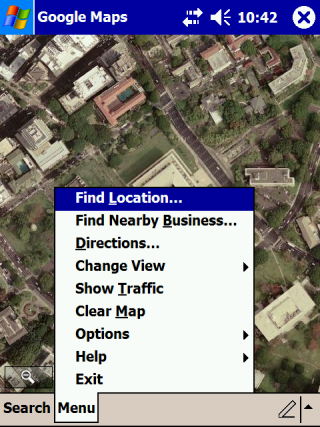
Google Maps for Windows MobileGoogle released a Google Maps client for Windows Mobile that installs from a CAB file that can be downloaded and installed directly from Google (no need to sync with a PC). It is also a native application. No Java Midlet needed. This means it is fast and looks good on a Windows Mobile device. I tested it on an old Dell Axim X50v running Windows Mobile 2003 Second Edition. As you can see from the screen cap, the satellite image view looks nice and clear on its screen and the menu looks like most other native applications.

You can download it directly to your device from: http://google.com/gmm/

The application can also show a traditional looking street map, locations of businesses, real-time traffic for certain cities, and driving directions. I’m very impressed by what I’ve seen. I hope we see more native Windows Mobile apps from Google in the future.

Mobile Devices
Pocket PC/Phone Edition
Smartphone
Windows Mobile

Comments (0)

Permalink

PSA: Windows Mobile Daylight Saving Time 2007 Update

On the odd chance that you don’t read the many other (and better known) sites and blogs that discuss Windows Mobile devices (ok, you may stop laughing and rolling around now), I thought I’d do my bit and offer this public service announcement. Last year the U.S. Congress decided to change the start and end dates for Daylight Savings Time in the US. This, of course, is causing all kinds of cyber hand wringing (for good reason I should add). Fortunately for we Windows Mobile users, Microsoft provides detailed instructions for dealing with this on a Pocket PC/Phone Edition or Smartphone. You can find the page linked below…
Daylight Saving Time 2007 Update

Mobile Devices
Pocket PC/Phone Edition
Smartphone
Windows Mobile

Comments (0)

Permalink

A Use for Those Old 802.11b WiFi Access Points

If you are like me, you probably have your old (and slow) 802.11b Access Point lying around somewhere.

If you have a Nintendo DS or Sony PSP portable gaming console, you might want to dust off the old 802.11b WAP and put it to use. Neither the DS nor the PSP support WPA encryption. So, you probably can’t use it with the 802.11g WAP you use for your notebook. They do, however, support WEP. So, you can dust off your WAP, put it on a different LAN segment (something like IPcop might do the trick) and use it exclusively for portable gaming net access.

Mobile Devices
Portable Gaming

Comments (0)

Permalink

More ActiveSync 4.5 Annoyances

ActiveSync 4.5 Connection SettingsMore ranting and grumblings from this blog. Sorry ’bout that.

When you install ActiveSync 4.5, it deletes all your existing Windows Mobile device partnerships. But, wait, that’s not all. If you previously synced wirelessly using Bluetooth (Microsoft removed the option to sync via WiFi way back in AS40), you have to rebuild that set of connection settings too.

This means you need to verify which serial port the Bluetooth adapter on your PC is using (COM4 in my case), set it, set the desktop BT to discoverable, then head back to your Pocket PC to BT pair with the desktop (or notebook). You should probably delete your old BT pairing setting before setting up the Pocket PC.

Mobile Devices
Pocket PC/Phone Edition
Windows Mobile

Comments (32)

Permalink

Copying Your Outlook Data from One PC to Another

Outlook 2003 Folder locationI upgraded one of my PCs from Windows XP Media Center Edition to Windows Vista Ultimate Edition last month. However, that PC was not my main PC (the one I sync my Windows Mobile devices to). If you go back through this blog, you’ll find that I did sacrifice a WM Smartphone to sync with the Vista box to test Windows Mobile Device Center (WMDC). So, how did I get the data over to the Vista box for testing? I just copied the files over. There are a number of ways to find where your Outlook.pst and other Outlook files are stored. Here’s how I do it (since I can never remember where it is from one time to another).

  • Start Outlook 2003
  • Click on File, then Open, the Outlook Data File.
  • Click on the pull-down menu at the top left
  • Note the path for your Outlook files
  • Exit Outlook
  • Copy the files to a thumb drive or some other sufficiently large storage device. If you use Outlook for email (I don’t), it may be large. If you don’t use it for email, it will probably fit on a small thumb drive. My Outlook.pst is just a bit over 5MB large. And, I turned off archiving.
  • Make sure Outlook 2003 (or 2007) on the Windows Vista PC is activated and ready to go.

I took my Outlook 2003 Outlook.pst file and plopped it in the Outlook 2007 folder on my Windows Vista PC. This migration process seemed to work fine for me. Your mileage may vary.

Mobile Devices
Pocket PC/Phone Edition
Smartphone
Windows Mobile

Comments (0)

Permalink

MyCalculator: Free Calculator for Pocket PCs

Each time I look at the calculator Microsoft provides on the Pocket PC or Smartphone, I am amazed at the fact that they have not improved it one bit in over a decade. The Pocket PC is a natural form factor for a great calculator. Fortunately, there are a number of freeware solutions available. Here’s one you might want to take a look at…

MyCalculator

There are versions for Windows Mobile, Windows, and Palm OS.

Mobile Devices
Pocket PC/Phone Edition
Windows Mobile

Comments (1)

Permalink

ActiveSync 4.5 Ate my Device Partnerships!

Although I have a PC setup running Windows Vista Ultimate Edition and the new Windows Mobile Device Center (ActiveSync replacement), my main PC that syncs with most of my Windows Mobile devices runs Windows XP Media Center. Since…

Microsoft ActiveSync 4.5

…was released for those of us still syncing Pocket PCs and Smartphones with XP, I decided to upgrade from 4.2 to 4.5 today. No problem right? Simple upgrade, right? Wrong…

The upgrade process itself went smoothly. However, when I brought up ActiveSync 4.5 (without any WM device attached to the PC), I noticed it had lost all of its device partnerships! This meant that I had to re-partner every device. The pre-Windows Mobile 5 devices partnered quickly as usual. However, because Windows Mobile 5 devices keep their PIM data in slow non-volatile RAM, the partnership for WM5 boxes took forever. I’m talking what seemed like 5 to 10 minutes per device.

The Windows Mobile platform is over 10 years old now. This sort of problem should have stopped happening during the last century. ActiveSync continues to be a user-hostile application and continues to earn its nickname of ActiveStink. Let’s hope its successor, WMDC, doesn’t earn its own pejorative nickname.

Mobile Devices
Pocket PC/Phone Edition
Smartphone
Windows Mobile

Comments (12)

Permalink

Hotmail Push Email for Windows Mobile 6

So, this push-email (made popular by the RIMM Blackberry) is all good and well. But, you are a Windows Mobile device user and do NOT use an Exchange Server for your email. So, big deal. Right?

Well, it turns out that push-email can be had with the free Hotmail service from Microsoft and the upcoming Windows Mobile 6 devices. Here’s a link to an article on the MSDN Blogs that describes how to set up a free push-email service.

Push Email with Windows Live Hotmail and Windows Mobile 6.0

Mobile Devices
Pocket PC/Phone Edition
Smartphone
Windows Mobile

Comments (4)

Permalink