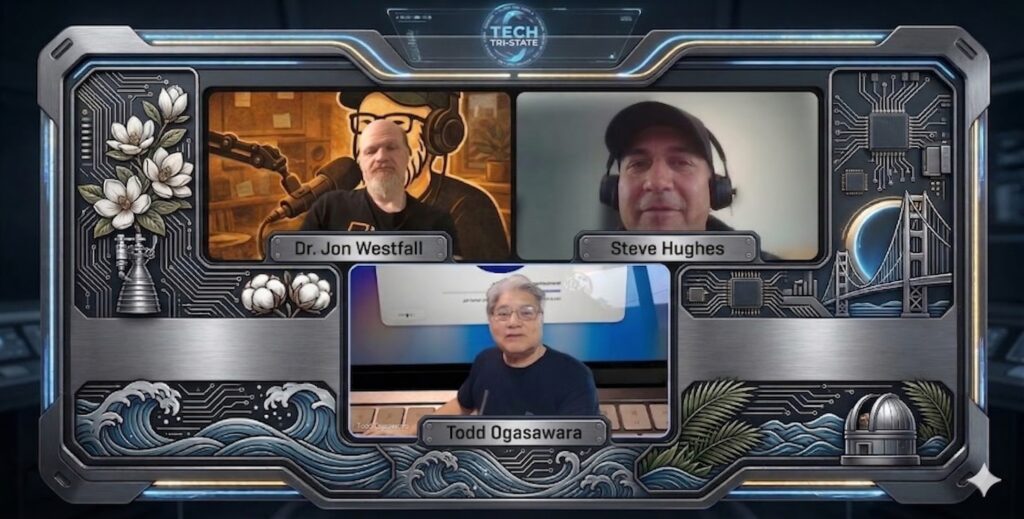

In this podcast Jon Westfall and I were joined by our long-time friend Steve Hughes, who returned to the show after a long period of heavy travel. I used the opening of the show to test a new Boya CM40 condenser microphone, comparing its sound quality to my MacBook’s built-in mic, my 4K USB camera, and my AirPods. It is always fun to play with new toys..
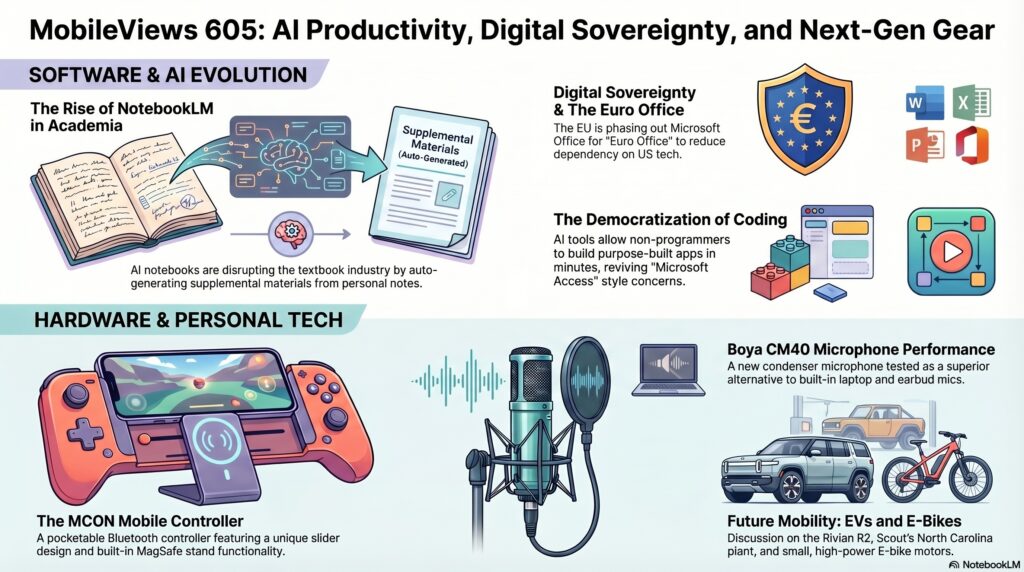
I have become a massive fan of NotebookLM and the new notebooks feature within Google Gemini. I recently fed hundreds of our podcast show notes and blog posts into a Gemini notebook to see how it handled the data. We discussed how this technology is becoming popular in academia as a tool for students to engage with material, though it poses a significant threat to the textbook industry by easily creating the same supplemental materials publishers charge for,. I’ve even been using it to build animated video presentations and conduct additional research, which are features included in the $20-a-month AI Pro subscription,.
Our conversation turned toward the concept of “digital sovereignty,” a movement in the European Union to reduce dependency on U.S. tech giants. We looked into the history of open-source office suites, from StarOffice to the current fragmentation of LibreOffice,. Interestingly, the EU is now looking toward “EuroOffice,” a fork of OnlyOffice (which itself has roots in Latvian and Russian development) to replace Microsoft Office. Steve, Jon, and I debated whether this would be a cleaner transition than past attempts, especially as corporate customers grow increasingly annoyed with the “nickel and diming” of subscription services.
Jon and I revisited the “technology gap” we see in students who have grown up exclusively on Chromebooks. Many struggle with the basic concept of a file structure or how to actually download a file to a specific directory. My own daughter recently joked that Windows is for “old people,” which signals a shift Microsoft should be wary of. However, Jon shared a positive note on the democratization of app development. He built a purpose-built fitness timer for his strength training in just 20 minutes using AI. While this “one-two punch” of AI interviewing and coding is powerful, I cautioned against the “Microsoft Access problem”—the risk of non-programmers building mission-critical tools that lack documentation or error-checking.
On the hardware front, Jon shared his first impressions of the MCON controller, a slider-style mobile gaming device that features a built-in MagSafe stand. While the buttons are a bit small for some, its “pocketability” makes it a strong contender for travel,. Steve updated us on the Sea Otter Classic, essentially the “CES for bikes,” highlighting new e-bike motors that are rejuvenating the industry,. We also touched on the EV market, specifically the Scout SUV and its move toward a range-extending motor. Steve even noted a great practical tip: using an EV as a reverse-load power source to keep a refrigerator running for up to two weeks during a blackout.
Listen to the full podcast to hear Steve’s story about meeting will.i.am at CES.
Available via Apple iTunes.
MobileViews YouTube Podcasts channel
MobileViews Podcast on Audible.com
